
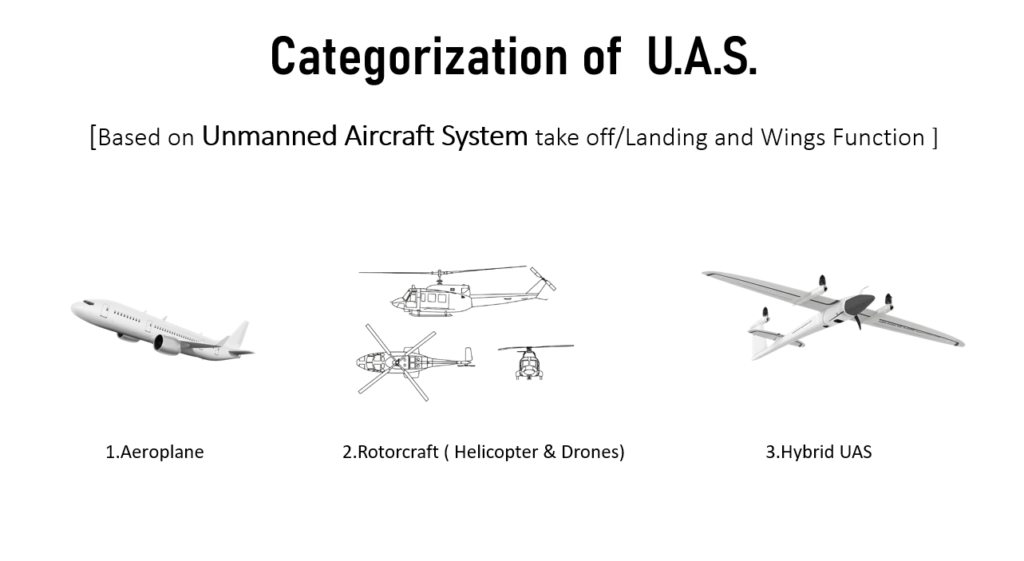
The Drone Rules, 2021 [ draft of the Drone Rules, 2021, which the Central Government had proposed to make in supersession of the Unmanned Aircraft System Rules, 2021, were published, as required under section 14 of the Aircraft Act, 1934 (22 of 1934), vide notification of the Government of India in the Ministry of Civil Aviation number G.S.R. 489 (E), dated the 15th July, 2021 “Act” means the Aircraft Act, 1934 (22 of 1934); “aeroplane” means any power-driven heavier than air aircraft machine deriving support for its lift in flight chiefly from aerodynamic reactions on surfaces which remain fixed under given conditions of flight; “authorised remote pilot training organization [ RPTO]” means an organisation authorised by the Director General for the purpose of imparting training under rule 39;
“Drone acknowledgement number [ DAN]” means the unique number issued by the digital sky platform under the voluntary disclosure scheme for unmanned aircraft systems in India;
“Drone” means an unmanned aircraft system[UAS]
“Geo-fencing” means restricting the movement of unmanned aircraft system within a defined airspace.
•Aircraft Rules, 1937
•Aircraft (Carriage of Dangerous Goods) Rules, 2003
“yellow zone” means the airspace of defined dimensions above the land areas or territorial waters of India within which unmanned aircraft system operations are restricted and shall require permission from the concerned air traffic control authority. The airspace above 400 feet or 120 metre in the designated green zone and the airspace above 200 feet or 60 metre in the area located between the lateral distance of 8 kilometre and 12 kilometre from the perimeter of an operational airport, shall be designated as yellow zone;
“red zone” means the airspace of defined dimensions, above the land areas or territorial waters of India, or any installation or notified port limits specified by the Central Government beyond the territorial waters of India, within which unmanned aircraft system operations shall be permitted only by the Central Government;
“hybrid unmanned aircraft” means a heavier-than-air unmanned aircraft capable of vertical take-off and landing which depends principally on power-driven lift devices or engine thrust for the lift during the flight regimes and on non-rotating airfoil for lift during horizontal flight;
“model remotely piloted aircraft system” means a remotely piloted aircraft system, with all-up weight not exceeding twenty-five kilograms, used for educational, research, design, testing or recreational purpose only and operated within visual line of sight;
“Operator” means a person engaged in, or offering to engage in, an operation involving an unmanned aircraft system;
“remote pilot” means an individual charged by the operator with duties essential to the operation of an unmanned aircraft and who manipulates the flight controls, as appropriate, during flight time;
“remote pilot licence” means the licence issued by Director General to any individual under rule 34;
“remotely piloted aircraft” means an unmanned aircraft that is piloted from a remote pilot station;
“remotely piloted aircraft system” means a remotely piloted aircraft, its associated remote pilot stations, the required command and control links and any other components as specified in the type design;
“Rotorcraft” means a heavier-than-air aircraft supported in flight by the reactions of the air on one or more power driven rotors on substantially vertical axes;
“type certificate” means a certificate issued by the Director General or any other entity authorised by the Director General, certifying that the unmanned aircraft system of a specific type meets with the equirements specified under these rules;
“type of unmanned aircraft system” means all unmanned aircraft systems of the same basic design including all modifications thereto, except those modifications which result in a change in handling or flight characteristics;
“Unique Identification Number” means the unique identification number issued for registering an unmanned aircraft system in India;
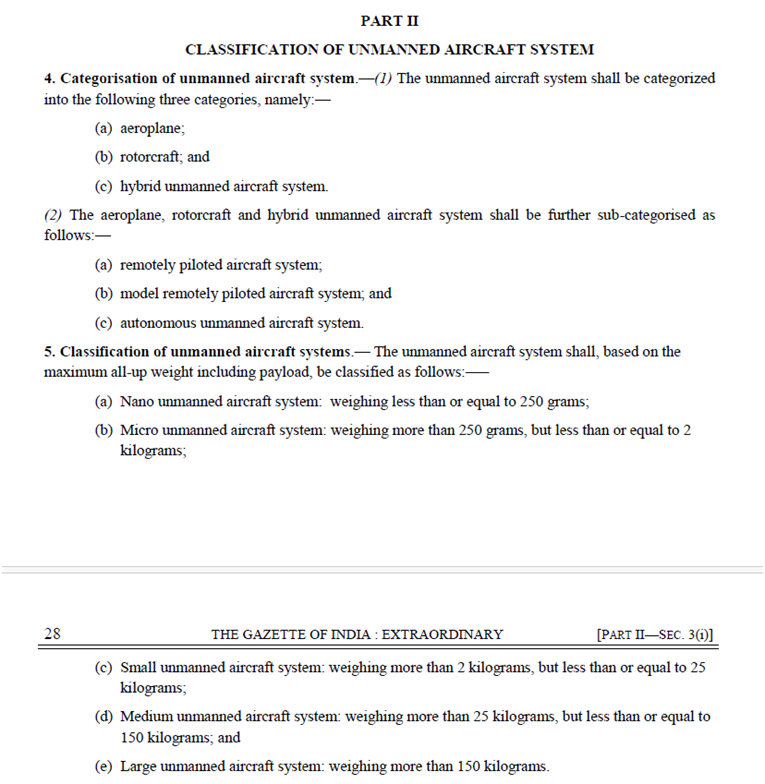
“unmanned aircraft system” means an aircraft that can operate autonomously or can be operated remotely without a pilot on board;
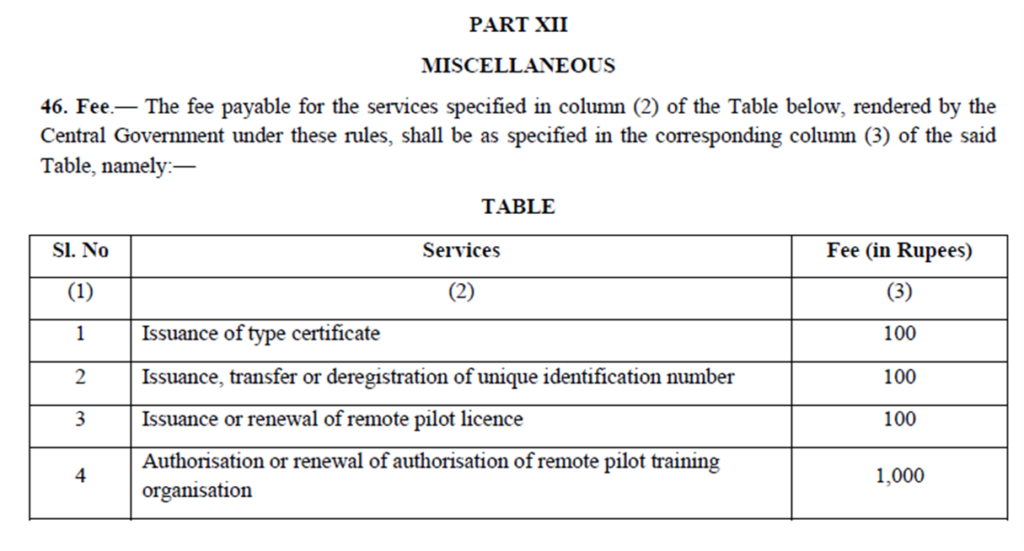
15. Application and procedure for registration.–– (1) Any person who intends to register and obtain a unique identification number for his unmanned aircraft system shall make an application in Form D-2 on the digital sky platform along with the fee as specified in rule 46 and provide requisite details including the unique number of the type certificate to which such unmanned aircraft system conforms to. (2) The digital sky platform shall verify the details and issue a unique identification number to the applicant. (3) The unique identification number of an unmanned aircraft system shall be linked to the unique serial number provided by the manufacturer and the unique serial numbers of its flight control module and remote pilot station. (4) No person shall replace the flight control module or remote pilot station of an unmanned aircraft system whose serial number is linked to such unmanned aircraft system’s unique identification number, without first updating, on the digital sky platform, the unique serial number of the new flight control module or remote pilot station, within a period of seven days from the date of such replacement or before operating such unmanned aircraft system, whichever is earlier.
16. Registration of existing unmanned aircraft systems.–– (1) A person owning an unmanned aircraft system manufactured in India or imported into India on or before the 30th day of November, 2021 shall,
within a period of thirty one days falling after the said date, make an application to register and obtain a unique identification number for his unmanned aircraft system and provide requisite details in Form D-2 on
the digital sky platform along with the fee as specified in rule 46.
(2) The digital sky platform shall verify the details furnished under sub-rule (1) and issue a unique identification number to the applicant, if the unmanned aircraft system–– 30 THE GAZETTE OF INDIA : EXTRAORDINARY [PART II—SEC. 3(i)]
(a) has a valid Drone Acknowledgement Number issued by the digital sky platform on or before the date mentioned in sub-rule (1);
(b) has a Goods and Service Tax paid invoice for the unmanned aircraft system; and
(c) is part of the list of unmanned aircraft systems published on the digital sky platform by the Director General.
Remote Pilot License
Eligibility. –An individual shall be eligible to obtain a remote pilot licence, if he––
(a) is not less than eighteen years of age and not more than sixty-five years of age;
(b) has passed class tenth examination or its equivalent from a recognised Board; and
(c) has successfully completed such training as may be specified by the Director General, from any authorised remote pilot training organisation.
34. Procedure for obtaining a remote pilot licence.–– (1) Any individual, who desires to obtain a remote pilot licence for any category, sub-category or class of an unmanned aircraft system, or a combination
thereof, shall complete the training specified by the Director General for such category, sub-category or class, and pass the tests conducted by the authorised remote pilot training organisation.
32 THE GAZETTE OF INDIA : EXTRAORDINARY [PART II—SEC. 3(i)]
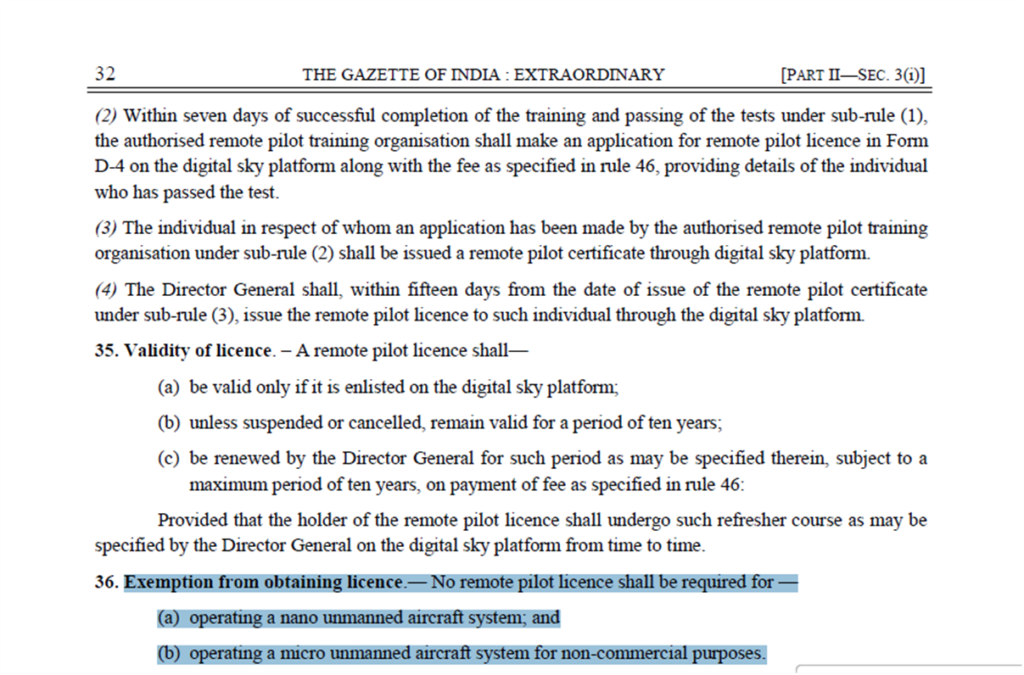
(2) Within seven days of successful completion of the training and passing of the tests under sub-rule (1), the authorised remote pilot training organisation shall make an application for remote pilot licence in Form
D-4 on the digital sky platform along with the fee as specified in rule 46, providing details of the individual who has passed the test.
(3) The individual in respect of whom an application has been made by the authorised remote pilot training organisation under sub-rule (2) shall be issued a remote pilot certificate through digital sky platform.
(4) The Director General shall, within fifteen days from the date of issue of the remote pilot certificate under sub-rule (3), issue the remote pilot licence to such individual through the digital sky platform.
35. Validity of licence. – A remote pilot licence shall––
(a) be valid only if it is enlisted on the digital sky platform;
(b) unless suspended or cancelled, remain valid for a period of ten years;
(c) be renewed by the Director General for such period as may be specified therein, subject to a maximum period of ten years, on payment of fee as specified in rule 46: Provided that the holder of the remote pilot licence shall undergo such refresher course as may be specified by the Director General on the digital sky platform from time to time.
36. Exemption from obtaining licence.–– No remote pilot licence shall be required for ––
(a) operating a nano unmanned aircraft system; and
(b) operating a micro unmanned aircraft system for non-commercial purposes.
44. Insurance.—(1) The provisions of the Motor Vehicles Act, 1988 (59 of 1988) and rules made thereunder shall apply, mutatis mutandis, to the third party insurance of unmanned aircraft system and
compensation in case of damage to life or property caused by such an unmanned aircraft system: Provided that a nano unmanned aircraft system may operate without third party insurance.
(2) A person operating a unmanned aircraft system may use an insurance product specially designed for such operations, as and when such insurance product is approved by the Insurance Regulatory and
Development Authority of India.
Deregistration of unmanned aircraft systems.–– (1) Where an unmanned aircraft system registered in a person’s name is either permanently lost or permanently damaged, he shall, on arriving at a reasonable
conclusion that it is so lost or damaged, apply for deregistration of such unmanned aircraft system by submitting an application in Form D-3 on the digital sky platform along with the fee as specified in rule 46.
Right of way. – No person operating an unmanned aircraft system shall violate the right of way of a manned aircraft and shall remain clear of all manned aircrafts
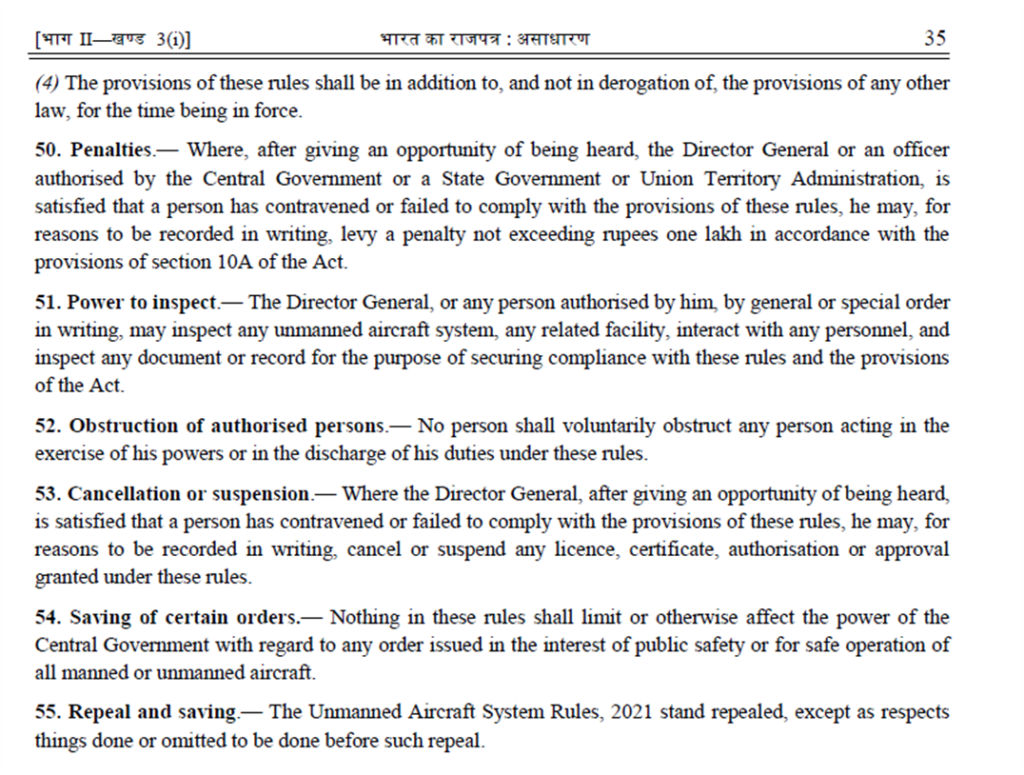
Penalties.–– Where, after giving an opportunity of being heard, the Director General or an officer authorised by the Central Government or a State Government or Union Territory Administration, is
satisfied that a person has contravened or failed to comply with the provisions of these rules, he may, for reasons to be recorded in writing, levy a penalty not exceeding rupees one lakh in accordance with the
provisions of section 10A of the Act.
51. Power to inspect.— The Director General, or any person authorised by him, by general or special order in writing, may inspect any unmanned aircraft system, any related facility, interact with any personnel, and
inspect any document or record for the purpose of securing compliance with these rules and the provisions of the Act.
52. Obstruction of authorised persons.— No person shall voluntarily obstruct any person acting in the exercise of his powers or in the discharge of his duties under these rules.
53. Cancellation or suspension.— Where the Director General, after giving an opportunity of being heard, is satisfied that a person has contravened or failed to comply with the provisions of these rules, he may, for
reasons to be recorded in writing, cancel or suspend any licence, certificate, authorisation or approval granted under these rules.

•Drone Sub- Category [UAS]
•As per operation by pilot
1. Remotely Piloted Aircraft (RPAS) : controlled by a human pilot from the ground using a remote controller.
Drone (aircraft)
Remote controller
Communication link
A camera drone flown manually by a pilot.
2. Model Remotely Piloted Aircraft (Model RPAS) : A small unmanned aircraft used only for recreation or hobby, not for commercial use.
Mostly toy or hobby drones
Limited range & height
No payload for business
A toy drone flown in a park for fun.
3. Autonomous Aircraft (Autonomous Drone) : flies automatically without real-time human control, based on pre-programmed instructions or AI.
No manual control during flight
Uses sensors, GPS, software
Human may only monitor A drone flying a pre-planned route automatically.
Forms
D-1 [APPLICATION FOR TYPE CERTIFICATE ]
D-2 [APPLICATION FOR REGISTRATION OF UNIQUE IDENTIFICATION NUMBER]
D-3 [APPLICATION FOR TRANSFER OR DEREGISTRATION OF UNMANNED AIRCRAFT SYSTEMS] – ☐ Permanently lost ☐ Permanently damaged
D- 4 [APPLICATION FOR REMOTE PILOT LICENCE (TO BE FILED BY RPTO]
D-5 [APPLICATION FOR AUTHORISATION OF REMOTE PILOT TRAINING ORGANISATION]

What it is : •A Non-Type Certified drone is a drone model that does NOT have DGCA type approval.
Who uses them
•Hobby users
•Imported drones
•Custom-built drones
•Older drones bought before TC rules
Limitations
•Cannot be registered (in most cases)
•Commercial flying NOT allowed
•Often restricted to R&D, training, or personal use
•Special permission may be required
In short: ❌ Non-Type Certificate = Without Type Certificate [ Not DGCA approved]
Abbreviations:
•UIN – Unique Identification Number
•DGCA – Director General of Civil Aviation
•RPC – Remote Pilot Certificate
•RPTO – Remote Pilot Training Organization
•NPNT – No Permission, No Take off
•VLOS – Visual Line of Sight
•UAS –Unmanned Aircraft system
•DAN –Drone acknowledgment number
•RPAS – Remote pilot aircraft system